Hands up if you also read academic articles from other fields than your own just for fun. I know I’m not alone in doing that, but I also know many think academic papers are strictly business.
During job interviews, an esteemed colleague of mine always asks the candidates to describe a scientific article from a different field than their own. This, to my astonishment, almost always turns out to be a real challenge, and the most verbal and well-rehearsed candidates get thrown into a loop of uhs and ums until they finally describe a paper that is from their own field, only a little further away than usual.
Well, honestly, I think that shouldn’t matter in a job interview, but it’s a question I just happen to be confident I could give a good answer to (as opposed to, e.g., “What do you think you’ll be doing in ten years?”—an even more stupid question given the situation of interviewees trying to answer what interviewers want to hear, alas).
OK, brace yourself for five such serendipitous discoveries from the vast archives of rarely clicked links:
The fox that walked across the Arctic
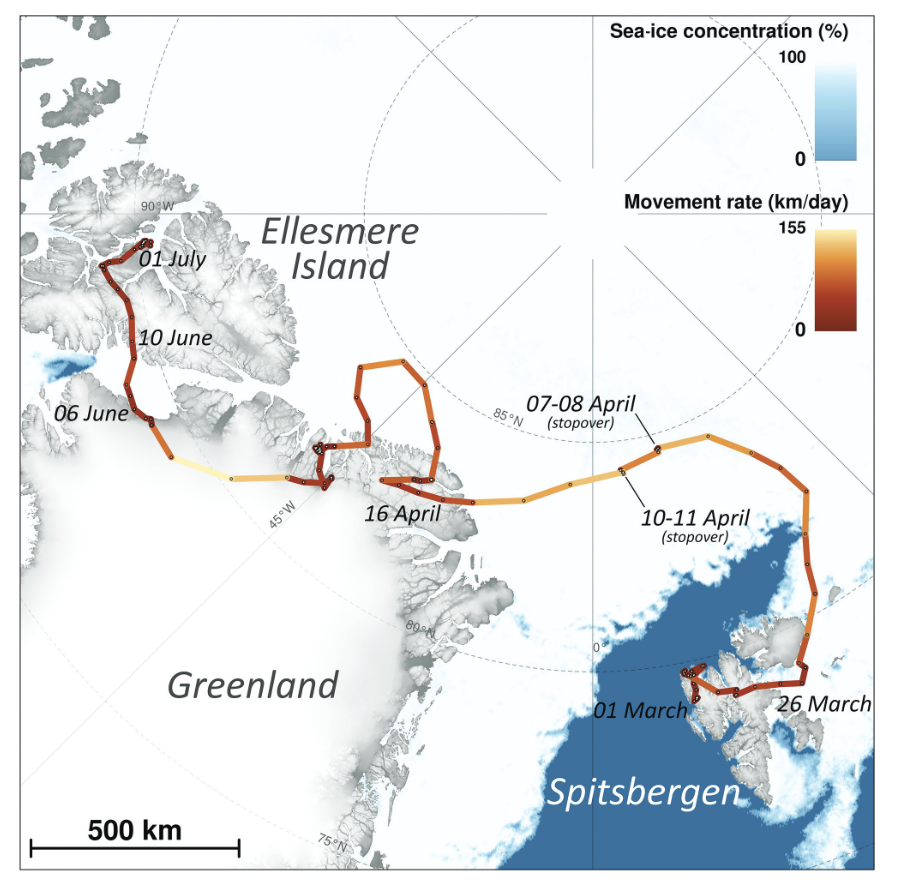
A paper about a female fox’s lonely 3506 km journey across the high Arctic—from Svalbard to Ellesmere Island. I’ve always had a soft spot for barren, hostile places and their tough inhabitants. A disappointment is that the paper never really rationalized the trip. Why did she start it? What forks in the paths of her life led her all the way to Canada? We also learn that her human counterpart (*), Fridtjof Nansen, was shocked to spot arctic foxes 85 degrees north.
(*) Nansen had a herohood waiting for him back in Norway, so the fox was, of course, cooler.
The Algerian rebel with a Chinese name
For someone who knows Chinese, it induces a lot of cognitive dissonance to learn that someone called Bu Ziyan—a perfectly possible pinyin of an unremarkable Chinese name, maybe卜子岩—is an Algerian anti-colonial rebel. Bu Ziyan built a following claiming he was the Mahdi, foreboding the end of times, and destined to defeat the French colonial forces. Now Mahdi claimants were not rare in the 1840s, but this contributed to a legend building up about him (spread by poets and bards in addition to regular gossip). Anyway, it was a truly interesting time and place I knew very little about before.
A windswept sense of belonging
Like the fox’s adventure, here’s another case of harsh-environment escapism. The paper is based on interviews with the inhabitants of two small villages in the Faroe islands and discusses, among other things, how the shared memory of storms helps tie the community together. Just like other famous sociology studies of Atlantic island communities—like Barnes’ “Class and committees in a Norwegian island parish” or Goffman’s Ph.D. thesis “Communication and conduct in an island community”—the villages are very tightly knit, and the family ties are plenty. The strong sense of community and attachment to the place is the basis for disaster resilience, where everyone is expected to help others repair storm damage.
Ready, set, theory
Ever since high school, I’ve been fascinated by set theory. It’s incredible how fast it goes from being a trite axiom drill, to immensely difficult and “apparently quixotically irrelevant” to the foundation of math it promises to be. But in this process, it is a fun brain teaser to try to figure out what’s going on. The quotation above is from a review paper by Kanamori and Magador, that is readable even to outsiders. To mention something newer, this cool paper uses a combinatorial game to tackle the problem of separating some types of sets.
Tocharian loan words
Comparative linguistics is also a fascinating topic. Some of the old guards at the department in Stockholm where I studied Chinese were always throwing linguistic curve balls at each other—”Did you know that [some etymological or phonological obscurity beyond all rhyme and reason]”, see, e.g., the pic below by the department’s godfather Bernhard Karlgren. It’s interesting how ill-documented the reconstructions of old languages are; such books and papers discuss their principles and sources a bit but then just present the results without motivation. Recently, I read a paper about Tocharian loan words in Chinese. The Tocharians were Buddhists speaking an Indoeuropean language. We know little about their culture and origin. It has been hypothesized the caucasian mummies discovered along the silk route in present-day China, and caucasian-looking monks on ancient scrolls, were Tocharians, but nobody really knows. Rather, we know them from their manuscripts.

Epilogue
Now I realize the unintended overabundance of papers about faraway places (in both space and time), I also like reading about virology (multi-component viruses!), psychology of religion, engineering, political science, etc. I’m already planning a follow-up in my mind.
 Petter Holme
Thanks for sharing these papers, Petter. The variety in topics is refreshing. How do you find interesting papers in unfamiliar fields, though? The vast majority seems impenetrable, boring, or both.
LikeLike
I arrived at all those through randoms walks with different starting points. The fox paper I found through the search for datasets about the Arctic. The Faroe Islands paper through checking grants awarded by https://www.nordforsk.org/ The Tocharian load word paper and the set theory stuff were more active search of what’s up with Tocharian/Set theory research today. Finally, how I found Bu Zhiyan, I completely forgot 🙂
LikeLike
Thanks for sharing!
LikeLike